
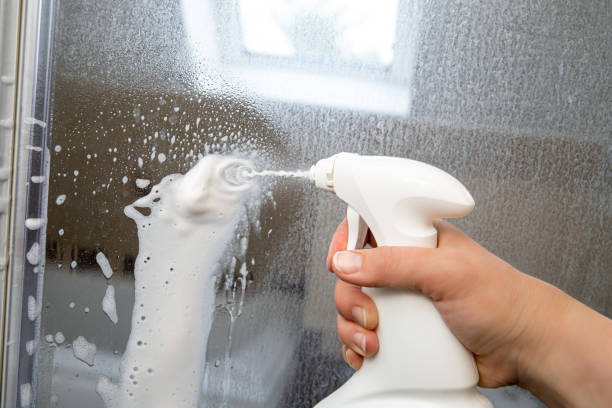
Hard water marks on shower glass come off with acid. White vinegar clears most of them. Citric acid clears the rest. Hard water stains on shower glass are calcium and magnesium. The water dries and leaves them behind. Soap scum then sticks to that mineral layer. This guide gives the method, the products that wreck glass, and the way to stop the spots.
Shower screens show it before anything else in the bathroom. The glass takes the spray every day. Then it dries in a warm room. The minerals stay on the surface.
One safety note before you start. Never mix an acid cleaner with bleach. The two give off chlorine gas in a small bathroom.
What are hard water marks on shower glass?
They’re mineral deposits. Hard water leaves calcium and magnesium on the glass as it dries. Soap scum sticks to that layer. The film turns cloudy and white. It hardens over a few weeks. Fresh marks wipe off with vinegar. Old marks need a long soak and a scrub.
The mineral comes from your water supply, not from your cleaning. The Australian Drinking Water Guidelines set the bands. Under 60 mg/L (as calcium carbonate) is soft. From 60 to 200 mg/L is good quality. From 200 to 500 mg/L brings increasing scaling problems. Over 500 mg/L is severe scaling.
The guidelines put the aesthetic limit at 200 mg/L. Above that, scale builds up fast in pipes and fittings. SA Water draws the line in the same place. More than 200 milligrams per litre counts as hard water.
Your glass sits below that line too. It just marks up more slowly at lower hardness levels.
What you need
- White vinegar, the plain household kind
- Citric acid powder for heavy build-up
- Bicarb soda
- A spray bottle
- A microfibre cloth and a soft sponge
- A plastic scraper or an old bank card
- A rubber squeegee
- Gloves, and an open window
Skip the steel wool. Skip the scouring powder. Both scratch glass, and a scratched screen holds mineral even better.
How to remove hard water marks with white vinegar
This clears light and medium marks. Give it 30 minutes.
- Open the window and turn on the exhaust fan.
- Mix equal parts white vinegar and warm water in the spray bottle.
- Wet the glass with warm water first. Dry glass drinks the spray too fast.
- Spray the whole screen from the bottom up. Working upward stops the drip lines.
- Wait 10 to 15 minutes. The vinegar needs contact time to soften the mineral.
- Spray again if the glass starts to dry out.
- Wipe with a damp microfibre cloth in small circles.
- Rinse with clean water, top to bottom.
- Dry the glass with a squeegee, then buff it with a dry cloth.
Warm vinegar works faster than cold. Heat it for 20 seconds in the microwave first. Don’t boil it, because the fumes get sharp.
Citric acid for heavy build-up
Citric acid beats vinegar on thick, chalky patches. It also smells better.
Mix two tablespoons of citric acid powder into 500 ml of warm water. Stir until it clears. Spray it on and leave it 15 minutes. Then wipe and rinse the same way.
For a stubborn band along the bottom rail, soak a cloth in the mix. Lay the wet cloth on the band. Leave it there for 30 minutes. The cloth holds the acid against the glass, so it can’t run off.
Bicarb paste for the worst patches
Some marks sit proud of the glass. You can feel them with a fingernail. Acid alone takes too long on those.
Mix bicarb soda with a little water into a thick paste. Spread it on the patch after the acid soak. Rub it gently with a damp sponge. The bicarb gives you a soft grit that won’t scratch glass.
Rinse it off well. Bicarb leaves its own white film if you let it dry.
What not to use on shower glass
Check your screen before you spray anything. Many Australian screens come with a factory coating that repels water. Acid strips that coating. Once it’s gone, the glass marks up faster than before. Ask your installer, or test a small corner near the hinge.
Keep acid off these:
- Coated or treated glass, unless the maker says acid is fine
- Natural stone hobs and sills, like marble and travertine
- Aluminium frames and the rubber seals, on a long soak
- Brass, gold, nickel and matte black tapware
Never mix bleach with vinegar or with any acid descaler. That mix releases chlorine gas. The CDC warns against mixing bleach with other cleaners for the same reason. Rinse the glass fully before you change product. Cleaning products can poison people. Ring the Poisons Information Centre on 13 11 26 if someone breathes in fumes.
Why some marks never come off
This is the part most cleaning guides skip. Not every mark is a deposit sitting on top.
Hot water carries a little dissolved silica. It dries on the glass with the calcium. Silica scale is different from calcium build-up. Standard acid struggles to dissolve it. Over years, it can leave a mark that looks etched into the glass. Some glass restorers treat this kind of mark as permanent. Polishing compound sometimes softens the look.
Here’s the test. Soak the patch in vinegar for 20 minutes, then wipe. Deposits go cloudy and lift. Etching stays exactly the same, and it looks the same wet or dry. If it doesn’t move after two soaks, it won’t move.
That’s the real reason to stop the marks early. You can clean a deposit. You can’t clean a scar.
Why the marks keep coming back
You cleaned the glass and it looks new. Two weeks later the film is back. The cleaning wasn’t the problem. Your water is.
Perth’s north is the clearest case in Australia. Two Rocks averages 228 mg/L (Water Corporation 2024-25 data). A screen there hazes over in a fortnight. Mandurah averages 50 mg/L in the same report. The same screen there stays clear for months.
So the fix has two halves. You clean what’s on the glass. Then you cut what lands on it next. We build hard water solutions for home bathrooms around that second half.
Not sure where your suburb sits? Our guide shows how to tell if you have hard water. A soap test takes five minutes.
How to stop hard water marks on shower glass
Three habits do most of the work. None of them takes a minute.
- Squeegee the glass after every shower. Wet mineral wipes off. Dry mineral sets.
- Leave the fan on for 20 minutes afterwards. Slow drying leaves heavier spots.
- Give the screen a vinegar spray once a month. A light film lifts in seconds.
Then deal with the water itself. Fit a shower filter between your shower arm and your showerhead. Ours reduces chlorine, heavy metals and sediment. It reduces calcium and magnesium too. It may help limit limescale on the showerhead and fittings. The glass then gets a lighter mineral load each shower.
A filter isn’t a substitute for the squeegee. It slows the build-up. It doesn’t switch it off.
Scale doesn’t stop at the screen either. The nozzles block up and the spray goes crooked. Our separate guide shows how to descale a shower head. The soak method there is different.
The same minerals also affect you
The film on your glass forms on you as well. Calcium and magnesium react with soap and leave a residue on the body. Some people get tight, dry skin after a shower. Our guide on hard water skin explains why. Hair picks it up too. Our guide to hair care in hard water covers what changes and what helps.
Your screen is just the part you can see.
Where to start
Spray the screen with warm vinegar tonight. Set a 10 minute timer. Wipe, rinse, squeegee, and see how much comes back.
Then cut the mineral at the source. POWERBOX Australia builds shower filtration for Australian water. Your glass then starts from a cleaner baseline.
Disclaimer
This article is general cleaning information. It isn’t advice for your specific glass, coating or tapware. Follow your screen maker’s care card where it differs from this page. A shower filter is not a medical treatment for eczema or any skin condition. If you have a diagnosed skin condition, consult a dermatologist.
Data note: the hardness bands come from the Australian Drinking Water Guidelines (NHMRC). The Perth figures are Water Corporation means for 1 July 2024 to 30 June 2025. The cleaning intervals are our own guidance, not an official standard.
Last reviewed September 2026 by Lena Hartman
Frequently Asked Questions
Does vinegar remove hard water stains from glass?
Yes, on most marks. Vinegar is a weak acid and it dissolves calcium and magnesium deposits. Use a 50:50 mix with warm water. Give it 10 to 15 minutes of contact time. Re-spray so the glass stays wet. Old, thick build-up needs two or three rounds.
Vinegar struggles on one thing. It can’t touch etched glass, because there’s no deposit left to dissolve.
What is the fastest way to clean a shower screen?
Warm vinegar spray, then a squeegee. Heat the vinegar for 20 seconds first. Spray the wet glass bottom to top. Wait 10 minutes while you clean the rest of the bathroom. Wipe with microfibre, rinse, and squeegee dry. Start to finish, about 15 minutes.
Speed comes from contact time, not from scrubbing harder. Let the acid do the work.
Can you use a magic eraser on shower glass?
You can, but go carefully. A melamine sponge works like very fine sandpaper. It takes off marks that acid leaves behind. It also dulls factory coatings and it can haze cheap glass. Test a low corner first. Use it damp, with light pressure, and never on a coated screen.
Acid first, sponge second. That order saves the coating on most screens.
How often should you clean shower glass?
Once a month in soft water areas. Every fortnight over 200 mg/L. A daily squeegee cuts both numbers roughly in half. Watch the glass, not the calendar. Cloudiness you can see from the doorway means the mineral layer already needs acid.
Homes with teenagers and long showers sit at the shorter end. More hot water means more deposit.
Why do hard water marks come back so fast?
Because the mineral is in the water, not in the dirt. Calcium and magnesium land on the glass with every shower. In Perth’s north, Two Rocks water averages 228 mg/L, so a screen hazes over in a fortnight. Drying the glass and filtering the shower water both slow it down.
Can hard water marks damage shower glass permanently?
Yes. Dissolved silica dries on the glass with the calcium and bonds into the surface over years. That etching is permanent and acid won’t lift it. If a patch looks the same after two vinegar soaks, it’s etched, not coated.