
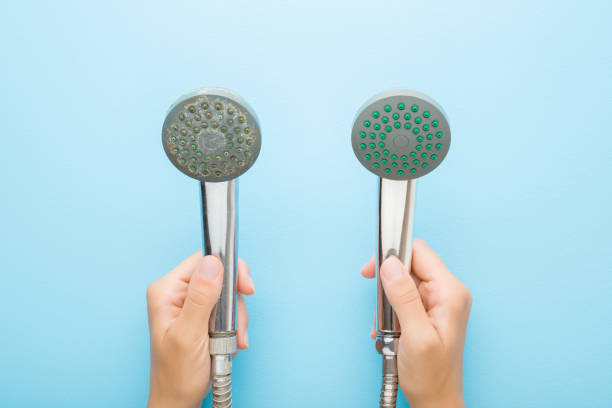
To clean a shower head, soak it in white vinegar for 30 minutes to 2 hours. Then scrub the nozzles and flush hot water through. That’s the whole job on most showers. Limescale is the white crust that blocks the nozzle holes. It comes from calcium and magnesium left behind when hard water dries.
This guide gives both methods, the soak time for your finish, and the things that wreck a shower head. It also shows how often to descale for your water, and how to slow the scale down.
Note: This is general cleaning advice, not a repair guide. Check your tapware maker’s care guide first. Some finishes can’t take vinegar or any acid.
What you need
- White vinegar, the cheap household kind
- A strong plastic bag, or a bowl deep enough to cover the face
- A rubber band, a cable tie or a hair tie
- An old toothbrush
- A soft cloth
- A shifter or pliers and a rag, only for the soak method
- Thread tape, only if you unscrew the head
Citric acid powder works too. Mix 1-2 tablespoons into 500 ml of warm water. It’s stronger than vinegar and it smells better.
How do you clean a shower head with vinegar?
Bag the head in white vinegar and leave it 30 minutes. Heavy scale needs 1-2 hours. Take the bag off, run hot water for 2-3 minutes, then scrub the nozzles with an old toothbrush. Wipe the face dry. You don’t need to remove the shower head.
This is the method for a normal clean. Follow it every few months.
- Half fill the bag with white vinegar.
- Slide the bag up over the shower head. The whole face must sit under the liquid.
- Tie it to the neck or the shower arm with a rubber band.
- Leave it 30 minutes. Give heavy scale 1-2 hours.
- Take the bag off and tip the vinegar down the drain.
- Run hot water for 2-3 minutes. This pushes loose grit out of the holes.
- Scrub the nozzle holes with the toothbrush.
- Rub the rubber nozzles with your thumb. Soft scale pops straight off.
- Wipe the face dry with the cloth.
Check the tie before you walk away. A bag full of vinegar is heavy. It drops off the arm if the band is loose.
How do you clean a blocked shower head?
Take it off and soak it face down. Unscrew the head from the arm with a rag over the jaws of your shifter. Stand it face down in a bowl of vinegar for 1-2 hours. Scrub, rinse, then refit with fresh thread tape. Run cold water first to flush grit out.
Use this one when the spray goes sideways or the pressure drops off.
- Turn the water off at the tap.
- Wrap a rag around the nut. This saves the finish from the tool marks.
- Unscrew the head from the shower arm, turning anticlockwise.
- Stand it face down in the bowl. The vinegar must cover the nozzle face.
- Soak it 1-2 hours. Check a plated finish at the 30 minute mark.
- Scrub the face and the inside of the inlet with the toothbrush.
- Rinse it under the tap until the water runs clear.
- Peel the old thread tape off the shower arm.
- Wind 2-3 turns of fresh tape on, clockwise.
- Screw the head back on by hand, then nip it up gently.
- Run cold water for a minute, then check for drips at the joint.
Some heads hide a small filter washer in the inlet. Pull it out with pliers and rinse it. Grit collects there and it chokes the flow.
Here’s a quick way to see if the clean worked. Hold a bucket under the head for 10 seconds before you start, and mark the level. Do it again after. More water in the same time means the holes are clear.
How long should you soak a shower head?
Chrome and stainless steel usually tolerate a 2 hour soak, though tapware makers advise against acid entirely. Plated finishes cope less well. Give brushed nickel, brass, gold and bronze 30 minutes, then rinse. Matte black and coloured finishes get warm soapy water only. Vinegar is an acid, and acid eats thin coatings.
| Finish | Vinegar soak | What to watch |
|---|---|---|
| Chrome | Up to 2 hours | The common finish in Australian bathrooms |
| Stainless steel | Up to 2 hours | Safe, but dry it to stop spotting |
| Plastic face, rubber nozzles | Up to 2 hours | Rub the nozzles by hand after |
| Brushed or polished nickel | 30 minutes, then rinse | Dulls if you leave it longer |
| Brass, gold or bronze | 30 minutes, or skip it | Unlacquered brass marks fast |
| Matte black or coloured PVD | Skip vinegar | Warm soapy water and a soft cloth |
Australian tapware care guides go further than we do. Brodware tells owners to keep caustics, abrasives, citrus acid, bleach, vinegar and alcohol off every finish it sells. For chrome and nickel it asks for warm water and a dry microfibre cloth.
So the safest order is simple. Read the care card that came with your tapware. Follow it if it disagrees with this page. A 30 minute soak and a soft brush will still lift most scale.
What should you never use on a shower head?
Bleach, because it kills bacteria but doesn’t dissolve mineral scale. Abrasive powders and scourers, because they scratch the finish. Wire brushes and pins, because they widen the nozzle holes. And never mix bleach with vinegar or any acid cleaner. That mix gives off chlorine gas.
Bleach and scale don’t react. Sodium hypochlorite isn’t an acid. Scale is calcium carbonate, so it needs an acid to break down. Vinegar and citric acid both do that job.
Mixing is the real danger. Bleach plus vinegar releases chlorine gas in a small, closed bathroom. Rinse the head fully before you change product. Open the window while you work. Cleaning products can poison people, so call the Poisons Information Line on 13 11 26 if someone breathes in fumes.
Two more habits to drop:
- A CLR type descaler is fine on chrome for short contact only. Keep it off gold, brass, nickel and coloured finishes, and rinse it straight away.
- A pin or a needle in the nozzle holes ruins the spray pattern. Rub the rubber nozzles instead.
Don’t boil a shower head in vinegar on the stove either. That trick goes around online. Heat softens the plastic parts and the O-rings inside the head.
How do you clean a shower head without vinegar?
Use citric acid powder. Mix 1-2 tablespoons in 500 ml of warm water and soak the same way. It cuts scale faster than vinegar and the smell fades quicker. Bicarb soda paste is the gentle option for coated finishes. It lifts soap film, but it won’t move thick scale.
Citric acid comes from the baking aisle of any supermarket. Make the mix fresh each time. Warm water dissolves the powder better than cold.
Bicarb works differently. It’s mildly abrasive and alkaline, so it moves soap scum and body oils. Mix it into a paste with water. Brush it on, wait 10 minutes, rinse it off.
Plain warm soapy water still does more than people think. Wipe the face after your last shower of the day. Scale needs water to dry on the surface to form.
How often should you clean a shower head?
Clean it every 3 months in most Australian homes. Soft water areas can stretch to 6 months. Over 200 mg/L, clean it every 4-6 weeks. A crooked spray or a drop in pressure means clean it that week. That holds whatever your water reads.
The Australian Drinking Water Guidelines set the hardness bands. Under 60 mg/L (as calcium carbonate) is soft, and it can be corrosive. From 60 to 200 mg/L is good quality. From 200 to 500 mg/L brings increasing scaling problems. Over 500 mg/L is severe scaling.
The guideline says it plainly. Water over 200 mg/L “can cause a rapid build-up of undesirable deposits, or scale, in hot water pipes and fittings”. SA Water draws the line in the same place. More than 200 milligrams per litre is considered hard water.
| Your water (as calcium carbonate) | Clean the shower head |
|---|---|
| Under 60 mg/L, soft | Every 6 months |
| 60-200 mg/L, good quality | Every 3 months |
| 200-500 mg/L, increasing scaling | Every 4-6 weeks |
| Over 500 mg/L, severe scaling | Monthly |
The bands are the ADWG’s. The cleaning interval is our own rule of thumb, from what we see on customer heads.
Perth’s north is the clearest case in the country. Two Rocks averages 228 mg/L (Water Corporation 2024-25 data). A head there crusts up in weeks. Mandurah averages 50 mg/L in the same report, so scale is slow there. Not sure where you sit? Our guide shows how hard Australian water is city by city.
Why does limescale keep coming back?
Because the minerals are in the water, not on the shower head. Every shower leaves a thin film of calcium and magnesium behind. The film dries and hardens into scale. Cleaning clears what’s there. Only treating the water slows down how fast it returns.
Scale forms where water sits and dries. The nozzle face is the worst spot, because drips hang there after you turn the tap off.
Three habits cut the rate down:
- Wipe the face with a dry cloth after the last shower of the day
- Run the head on hot for 30 seconds after a long cold shower, to clear standing water
- Give it a 30 minute vinegar soak on a schedule, not when it blocks
Filtering the shower water is the other lever. Fit a shower head filter for hard water between your shower arm and your head. It reduces chlorine, heavy metals and sediment. It reduces calcium and magnesium too. It may help limit limescale on the showerhead and fittings.
Be clear about what it isn’t. It’s not a water softener, and it doesn’t treat the whole house. It works on the water at that one shower.
Already running a filter? Then clean the head on the day you swap the cartridge. The two jobs take 10 minutes together. Our guide on how often to change shower filter covers the signs that a cartridge is spent.
Scale doesn’t stop at the head. It marks the glass, the tiles and the tap spout too. We cover limescale on a shower screen in its own guide, because the method there is different.
Where to start
Bag the head in vinegar tonight. Set a 30 minute timer. Scrub, flush, and run the bucket test to see what you got back.
Then deal with the cause. Fit a shower filter to reduce chlorine, calcium and magnesium at the shower. It may help slow how fast the scale comes back.
Disclaimer
This article is general information about cleaning a showerhead. It is not medical advice and it is not plumbing advice for your specific fitting. Follow your tapware maker’s care instructions where they differ from this page. A shower filter is not a medical treatment for eczema or any skin condition. If you have a diagnosed skin condition, consult a dermatologist.
Data note: the hardness bands are from the Australian Drinking Water Guidelines (NHMRC). The Perth figures are Water Corporation means for 1 July 2024 to 30 June 2025. The cleaning intervals are our own guidance, not an official standard.
Last reviewed September 2026 by Lena Hartman
Common questions about cleaning a shower head
Can you leave vinegar on a shower head overnight?
Generally yes, on chrome or stainless steel, as our guidance rather than the maker’s. An overnight soak handles scale that a short soak won’t. Don’t do it on brass, gold, nickel or coloured finishes. Acid sits on a thin coating for eight hours and dulls it. Stick to 30 minutes on those.
Does CLR work on shower heads?
It works, because it’s an acid descaler. Keep the contact time short and rinse well. Use it on chrome or stainless steel only. It can stain gold, brass, nickel and matte black finishes. White vinegar does the same job slower, for a fraction of the cost.
How do you unblock shower head nozzles?
Soak the face in vinegar for 1-2 hours first. Then rub the rubber nozzles with your thumb, and brush the holes with an old toothbrush. Pull out the inlet filter washer and rinse the grit off. Don’t poke the holes with a pin, because that widens them.
Will cleaning the shower head fix low water pressure?
Sometimes. Blocked nozzles and a clogged inlet washer both cut the flow, and a soak fixes both. Test it with a bucket for 10 seconds before and after. No change means the problem is elsewhere, like the tap, the valve or the mains pressure.
Can you clean a shower head without taking it off?
Yes. The bag method does it in place. Fill a plastic bag with white vinegar, slide it over the head, and tie it to the arm. Leave it 30 minutes to 2 hours. This is the better option on old fittings, where unscrewing risks a leak.
Is bleach safe on a shower head?
Bleach won’t dissolve limescale, so it’s the wrong product. It also strips some finishes and it damages rubber seals over time. Never use it after an acid cleaner, because the mix gives off chlorine gas. Use white vinegar or citric acid instead.